Implant or bridge: what to discuss at your consultation

When a tooth is missing, you want to understand not only the price but the whole restoration process. Implants and bridges work differently. Comparing them is useful after your situation has been assessed, with questions about neighbouring teeth, timing, care and what the plan includes.

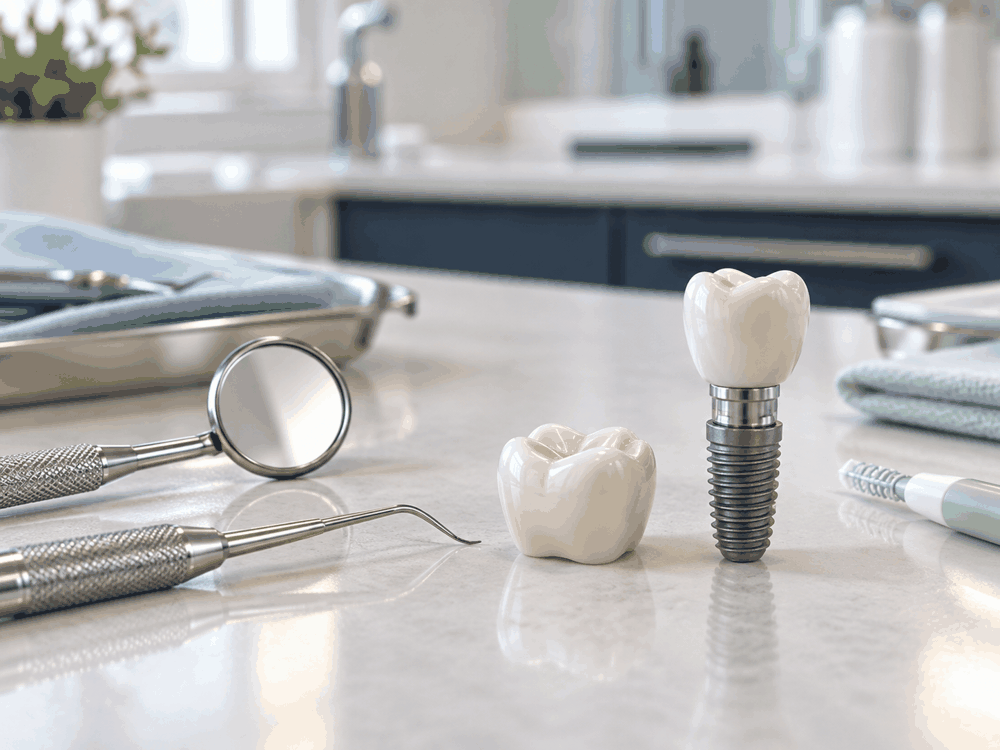
Illustration of an implant with a crown beside a model of a natural tooth

What is the main difference?

An implant is surgically placed in the jaw to support an artificial tooth or another restoration. A crown is the visible part of a restoration, not another name for an implant.

A bridge replaces one or more missing teeth. A traditional bridge is supported by neighbouring teeth; implant-supported bridges also exist. First, clarify which option is being proposed.

What to ask about support

For a bridge, the reliability of the supporting teeth matters. Ask how their condition affects the plan and what needs to be done to these teeth.

If you are considering an implant, discuss your health, healing conditions and individual risks. Smoking can impair healing. Suitability is decided after assessment, not from a single photograph of a smile.

A useful question is: “Which options suit my situation, and why do you recommend this one?” Ask the dentist to distinguish necessary procedures from possible additional stages.

How to discuss stages and a temporary solution

With implants, placement of the support, healing and making the final restoration may be separate stages. The appropriate sequence and temporary restoration are discussed individually.

Ask what will happen between visits: a temporary restoration, restrictions, checks and the next step. Mention travel plans before choosing dates. Do not compare options only by a promise of “one visit”.

How to compare estimates

If both options are genuinely being considered, ask for two comparable estimates. Check whether they include assessment, preparation, temporary and permanent restorations, additional stages and follow-up visits.

Ask what may change the scope or cost and when this would be agreed. A line labelled “implant” or “bridge” does not describe the entire treatment process. Figures from someone else's case do not show what your plan will cost.

What happens after the restoration?

Care and follow-up are needed after a restoration is fitted, too. Implants need cleaning and regular visits as advised by a professional. Complications are possible; results cannot be guaranteed in advance.

Ask to be shown how to clean your restoration and which aids suit it. Check whom to contact with questions and when your follow-up is scheduled. These answers also matter when choosing an option.

Questions and answers

Is a bridge always supported only by natural teeth?

No. There are tooth-supported and implant-supported bridges; clarify the type of restoration being proposed.

Are an implant and a crown the same thing?

No. An implant provides support, while a crown may be the visible part of the restoration fitted onto it.

Does an implant mean no further care is needed?

Regular cleaning and follow-up according to individual advice are needed. Implants can also have complications.

Sources
  1. ADA / MouthHealthy — Implants
  2. ADA / MouthHealthy — Bridges
  3. FDA — Dental Implants: What You Should Know

Discuss the next step

To discuss replacing a missing tooth, contact YouDent. At the consultation, ask about suitable options, stages and what the estimate includes.

Contact YouDent

This material provides general information and does not replace an individual consultation.
Privacy and cookies

Organisation and contact details

U-Dent s.r.o. · IČO 28143876

Registered address
Peroutkova 570/83, Jinonice (Praha 5), 158 00 Praha
Clinic address
Peroutkova 531/81, 158 00 Praha
Legal contact
+420 776 314 587
Appointment phone number
+420 775 555 191
Director
Vitalii Iudin

This website runs on Tilda. Tilda's basic statistics count visits without analytics cookies. Google Analytics 4 is connected only with your separate consent to analytics: Google receives information about the page visit and device and uses analytics cookies. Permission for the Google Maps map does not include analytics. You can change or withdraw your consent through cookie settings.

The embedded Google Maps map is connected after you give permission. You can change your choice in cookie settings.

Calls or messenger links are opened only when you click. When you visit external services, their data-processing terms apply.

Cookie settings

Contact details and address

Google Maps is available after you allow the relevant cookies.

Open Google MapsCookie settingsPrivacy and cookies
Cookie settings
Analytics, advertising measurement including phone calls, and the external map require separate consent. You can change your choice in cookie settings.
Privacy and cookies
Cookie settings
Cookie and external content settings
Analytics, advertising measurement including phone calls, and the external map require separate consent. You can change your choice in cookie settings.
Privacy and cookies
Essential technologies
These save your cookie preferences and support the website's operation and security. This category is always enabled.
Google Analytics 4
Disabled
Allows Google Analytics 4 to use analytics cookies and receive page visit and device data. Enabled only after your consent. Google Maps permission does not enable analytics. You can change or withdraw your choice in cookie settings.
Advertising and phone call measurement
Disabled
Allows Google Analytics 4 and Google Ads to associate clicks on website buttons with an advertising click using cookies and click identifiers. Consent to Google Analytics 4 is also required. Message and form contents, the address of the specific treatment page you visit and its title are not sent. Ad personalization and remarketing are disabled. You can change or withdraw your choice. On the language homepages Google Ads may replace the telephone number to measure calls following an ad click. Google processes the IP address, device data, cookies and click identifiers; for a call, connection data, time, duration and caller number where available. This code does not enable call recording. The new call measurement starts only after renewed explicit consent to both analytics and this measurement.
External Google Maps map
Disabled
Allows the embedded map to load from Google's servers. When it loads, Google receives request data, including your IP address, and may use its own storage technologies. The map does not load until you give permission; the address and a regular map link remain available.